

Section 3
3The InnovaForge Framework
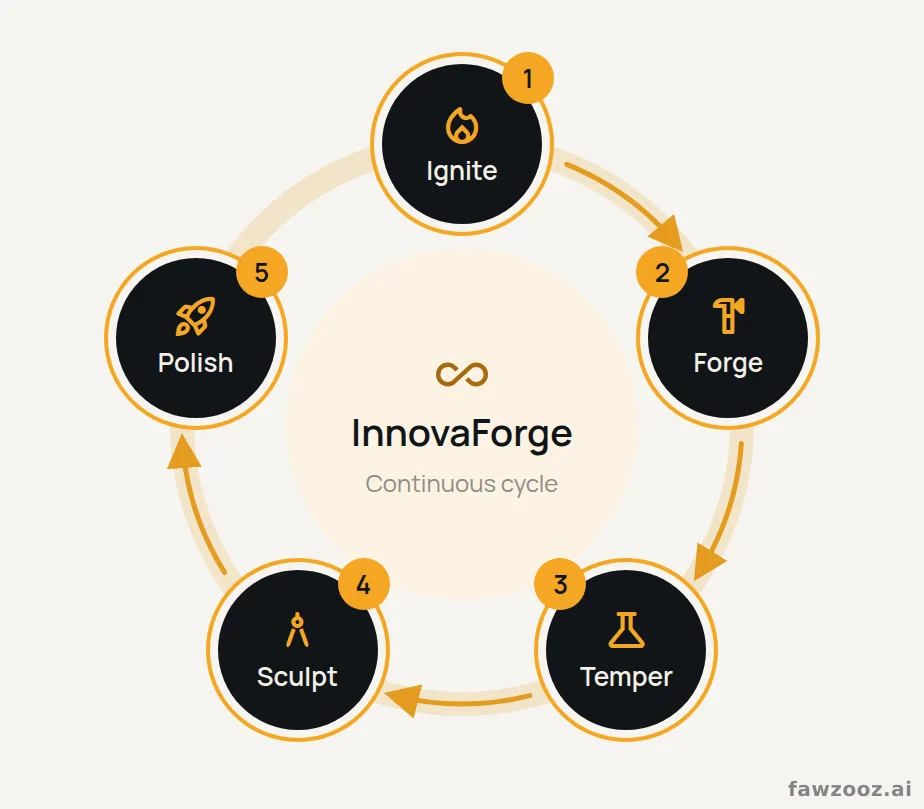
InnovaForge consists of five dynamic, iterative stages that form a continuous cycle of improvement. It is released under an open licence so that any team, school or institution can adopt and adapt it.
Text in this figure
InnovaForge · Continuous cycle · Ignite · 1 · Forge · 2 · Temper · 3 · Sculpt · 4 · Polish · 5 · Figure 1. The InnovaForge cycle. Learnings from Polish feed the next Ignite.
Guiding principles
- 01Collaborate with purpose
Innovation is a team sport. Psychological safety and diverse perspectives, from engineering to marketing to customer support, produce stronger ideas. - 02Embrace iteration
Failure is data, not an endpoint. Every prototype and failed experiment informs the next step. - 03Adapt and evolve
A guide, not a rigid process. Stages and tools scale to the size, context and constraints of each project.
Stage 1 of 5 · The Spark of Insight
Ignite
Objective
Move from broad curiosity to a specific, well-defined problem or opportunity worth exploring.
Core action
Identify opportunities
- Activities: Problem finding beneath surface issues; inspiration mining across reports, competitors, customers and unrelated fields; and open, judgment-free brainstorming.
- Techniques: Brainstorming, the 5 Whys, Provocation.
- Exit criteria: One to three prioritized problems or opportunities and a bank of initial ideas, recorded on the canvas.
Stage 2 of 5 · Shaping the Concept
Forge
Objective
Transform raw ideas into structured, testable concepts with a clear value proposition.
Core action
Define the value proposition
- Activities: Concept statements that define purpose, audience and features; a thirty-minute Lean Canvas; and low-fidelity prototypes such as sketches, wireframes or a “future press release”.
- Techniques: SCAMPER, TRIZ, Mind mapping.
- Exit criteria: A clear value proposition and a low-fidelity prototype ready for first feedback.
Stage 3 of 5 · Testing and Iteration
Temper
Objective
Expose the concept to real-world feedback and data, strengthening it through rapid cycles of learning.
Core action
Validate with users
- Activities: Build a minimum viable product; run interviews, analytics, A/B and usability tests with five to ten users per cycle; iterate or pivot on evidence through Build–Measure–Learn.
- Techniques: Design Thinking, Storyboarding.
- Exit criteria: Core assumptions validated or invalidated with real user data; learnings and pivots recorded.
Stage 4 of 5 · Planning for Impact
Sculpt
Objective
Create a clear, actionable, strategic roadmap for developing and launching the validated solution.
Core action
Create an actionable roadmap
- Activities: Strategic alignment with the mission; agile planning in user stories and sprints with OKRs and a three-to-six-month roadmap; resources, budget and a simple risk matrix.
- Techniques: SWOT analysis, Six Thinking Hats.
- Exit criteria: A roadmap with objectives and success metrics agreed by the team and stakeholders.
Stage 5 of 5 · Launch, Learn, and Scale
Polish
Objective
Execute the plan, measure real-world impact, and embed the learnings back into the organization.
Core action
Deliver, measure, and learn
- Activities: A full or phased launch guided by a checklist; tracking the OKRs and KPIs set in Sculpt; and a retrospective two to four weeks after launch: what worked, what did not, what we learned.
- Exit criteria: Initial performance data analyzed and a decision taken: iterate, scale or sunset. The cycle begins anew.
Tip: use ← → to move between sections.