Cognitive SASE Architecture

Book

Request the PDF

Enter your email and we will send you a code; your request is then recorded at once, and a link to download your copy reaches your email.

By continuing, your email and progress are kept in your account. Privacy

* The file is for your own reading; sharing follows the terms of use, and commercial use is not permitted.

Reading progress
0 of 10 sections read
8 / 10

Section 06

66. The Pathway to Agentic AI Governance

1 min read8 of 10Read it in the book · page 20

The Cognitive SASE Architecture is designed specifically to serve as the foundational sensory and actuation layer for Agentic AI integration. In the next phase of development, rule-based SIEM alerting is augmented by autonomous agents deployed within the mesh itself.
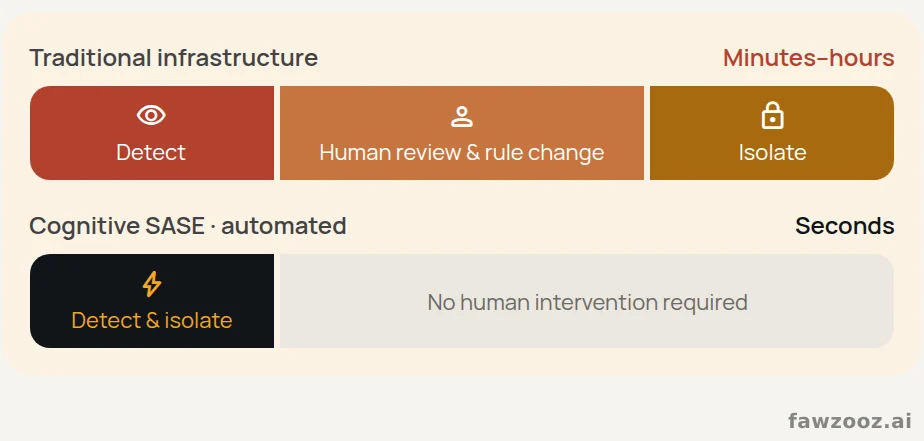
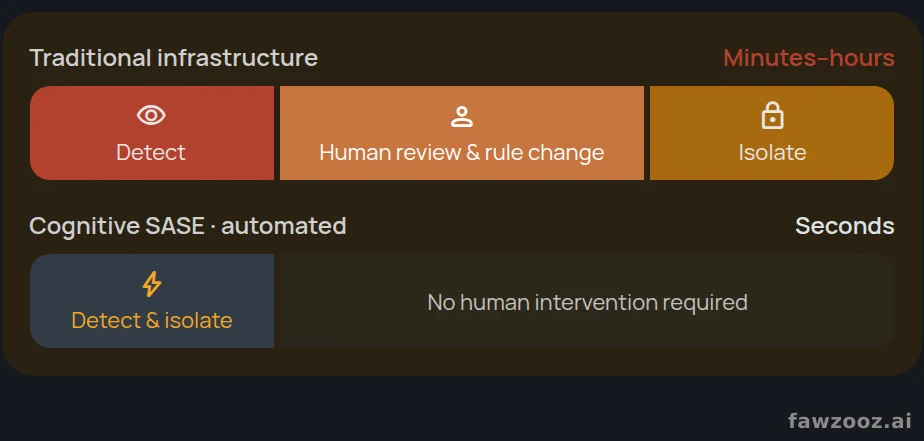
Incident response, time-to-isolate. Automating containment removes the human decision loop, reducing the response window from minutes–hours to seconds; actual latency depends on detection rules and agent reporting intervals. Bars are indicative, not measured.Incident response, time-to-isolate. Automating containment removes the human decision loop, reducing the response window from minutes–hours to seconds; actual latency depends on detection rules and agent reporting intervals. Bars are indicative, not measured.
Figure 5. Incident response, time-to-isolate. Automating containment removes the human decision loop, reducing the response window from minutes–hours to seconds; actual latency depends on detection rules and agent reporting intervals. Bars are indicative, not measured.
Text in this figure

Traditional infrastructure · Minutes–hours · Detect · Human review & rule change · Isolate · Cognitive SASE · automated · Seconds · Detect & isolate · No human intervention required

These agents process the encapsulated telemetry pipeline in real time, applying cognitive security models to detect sophisticated manipulation — including attacks aimed at the reasoning of human operators rather than at systems directly. Because the underlying network already supports automated node isolation through the combination of RoaS segmentation and mesh control, an agentic layer inherits the native capability to govern, defend, and dynamically adapt the infrastructure: perception and actuation are already in place; only judgment is added.

Tip: use ← → to move between sections.