

Section 03
33. Encapsulated Telemetry: The In-Overlay SIEM Pipeline
To achieve Zero Trust without weakening the mesh’s confidentiality guarantees, security telemetry is deployed entirely within the logical boundaries of the overlay. Three properties define the pipeline.
- 3.1Minimal exposure
The central SIEM manager is anchored in a highly restricted management VLAN at the primary stable node. Endpoint agents deployed across all nodes never report to a public or physical LAN address; they bind exclusively to the overlay interface, so the manager exposes no internet-facing attack surface. - 3.2Encrypted transport
Agent registration and log event data are forced through the encrypted P2P tunnels. Security events — which often contain credentials, hostnames, and incident detail — therefore remain confidential in transit and never touch third-party infrastructure in cleartext. - 3.3VLAN sub-interface enforcement
The SASE edge agent routes telemetry from isolated development VLANs directly across the encrypted trunk into the manager's isolated environment, ensuring that compromised endpoints cannot pivot laterally into the security infrastructure itself.
Text in this figure
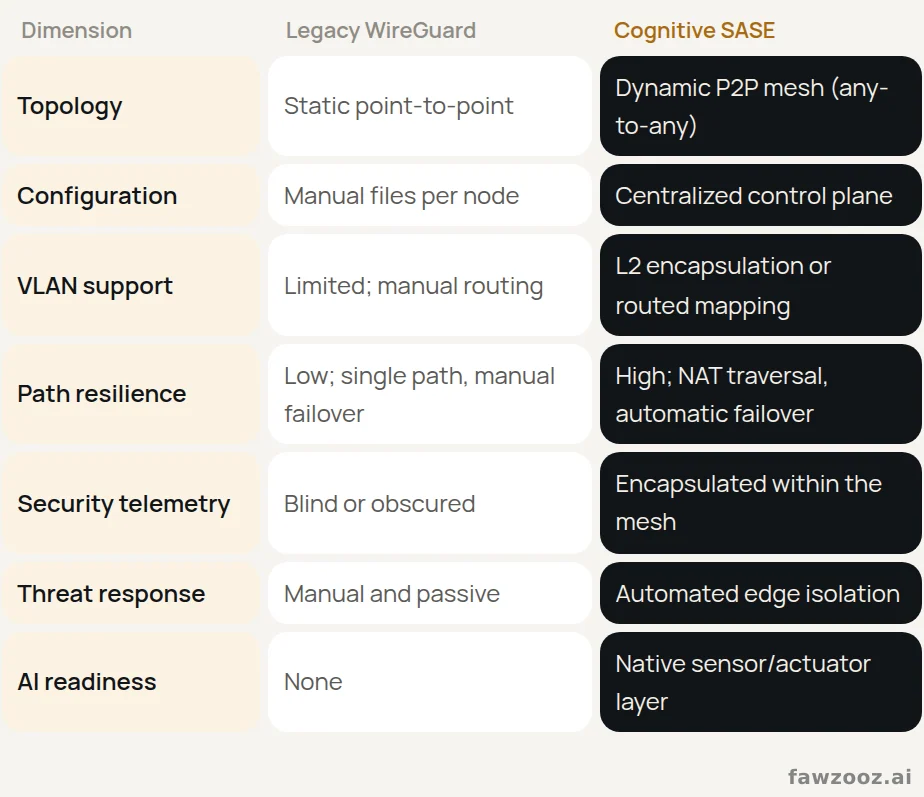
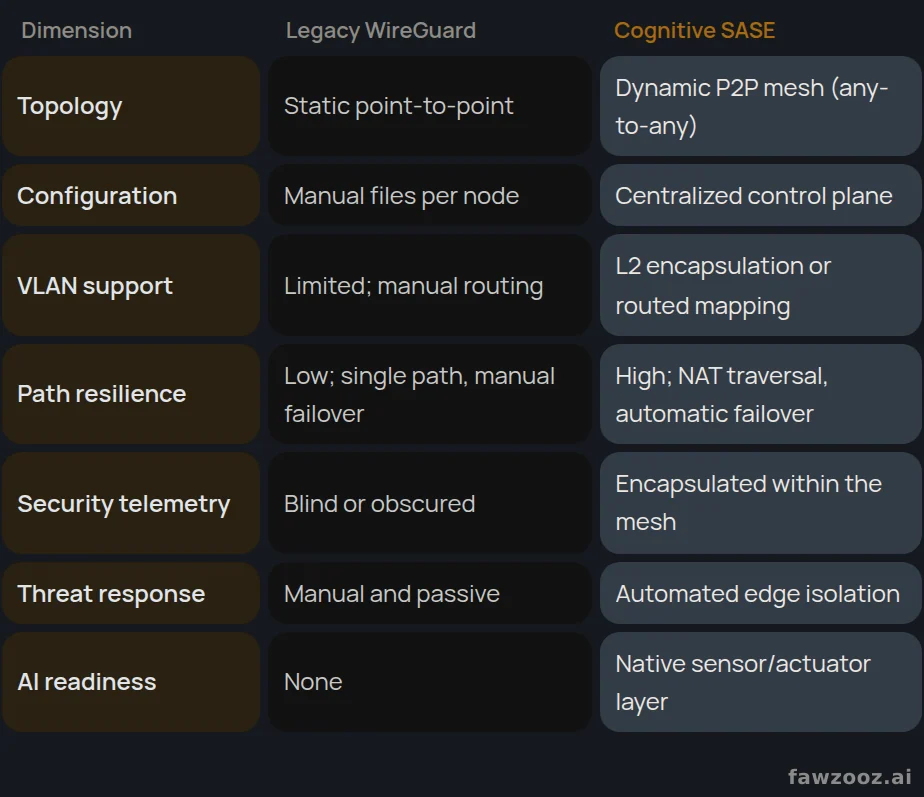
Dimension · Legacy WireGuard · Cognitive SASE · Topology · Static point-to-point · Dynamic P2P mesh (any-to-any) · Configuration · Manual files per node · Centralized control plane · VLAN support · Limited; manual routing · L2 encapsulation or routed mapping · Path resilience · Low; single path, manual failover · High; NAT traversal, automatic failover · Security telemetry · Blind or obscured · Encapsulated within the mesh · Threat response · Manual and passive · Automated edge isolation · AI readiness · None · Native sensor/actuator layer
Tip: use ← → to move between sections.