

Section 07
77. Vibe Orchestration and the Cognitive Security Stack
In vibe orchestration, AI is persistent: it makes decisions, executes logic and manages environments. This exposes a new threat surface — the cognitive layer. Cognitive security is the discipline of protecting that layer, and the human operating system around it, from manipulation, deception and systemic disruption.
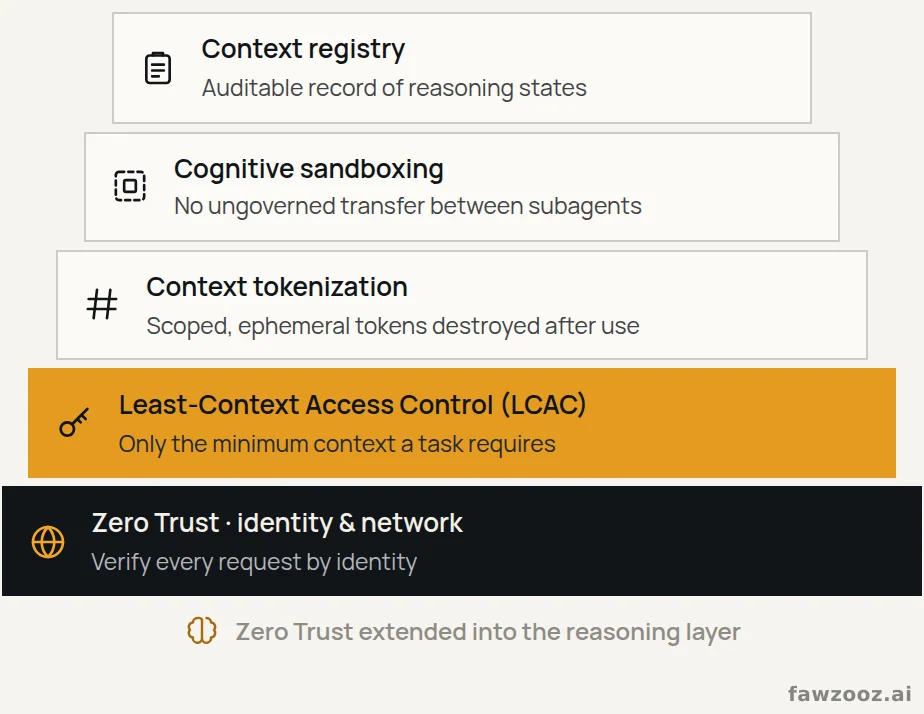
- Context tokenization: Prompts, system files and retrieval vectors are broken into scoped, ephemeral tokens, so data stays isolated and is destroyed after execution.
- Cognitive sandboxing: Prevents the ungoverned transfer of knowledge, intent or system variables between subagents, mitigating data drift and cross-context bias.
- Context registry: Logs the model’s reasoning states and decision paths without storing sensitive prompt content, giving an unalterable, auditable record of the AI’s “thought process”.
Text in this figure
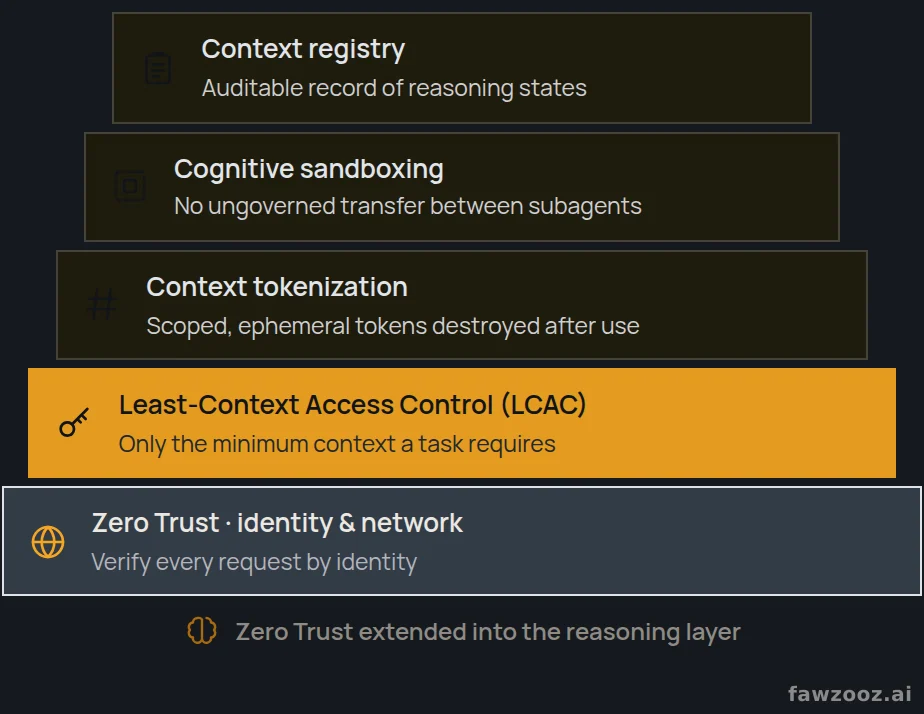
Context registry · Auditable record of reasoning states · Cognitive sandboxing · No ungoverned transfer between subagents · Context tokenization · Scoped, ephemeral tokens destroyed after use · Least-Context Access Control (LCAC) · Only the minimum context a task requires · Zero Trust · identity & network · Verify every request by identity · Zero Trust extended into the reasoning layer · Figure 11. The Cognitive Security Stack, built on Least-Context Access Control and extending Zero Trust into the reasoning layer.
Core concept · The question is no longer who can act, but what an agent can know
Zero Trust verifies every request and restricts privilege by identity — insufficient for AI that reasons, reflects and writes its own logic. LCAC extends Zero Trust into the reasoning layer by restricting the data supplied to a model’s context to the absolute minimum a task requires, preventing context leakage and manipulation.
Tip: use ← → to move between sections.