

Governing Information Security
Chapter 1: Why Information Security Needs Governance
Where this chapter sits in ISO/IEC 27001: The introduction (0.1 and 0.2), and the idea of a management system that runs through every clause from 4 to 10.
1.1 Information Is the Business
Think of any organisation you know well: a hospital, a bank, a school, a factory, a ministry, a shop with a website. Now take away its information for one day. No patient records, no account balances, no timetables, no orders, no contracts, no emails. The building is still standing and the people are still at their desks, but the work stops. Doctors cannot see what a patient is allergic to. Tellers cannot tell a customer what is in their account. The warehouse does not know what to ship.
That simple thought experiment shows something that has changed over the last twenty years. Information is no longer something an organisation has, like furniture or vehicles. It is a large part of what the organisation is. Its knowledge of its customers, its designs, its prices, its history and its plans are its real capital. When that information is lost, changed or exposed, the organisation itself is harmed.
This is why information security has moved out of the server room and into the boardroom. When a customer list leaks, the damage is to trust, revenue and reputation, not to a disk. When ransomware locks a hospital’s systems, the harm reaches patients, and operations are cancelled. When a supplier is breached, every one of its customers inherits the problem. When a false invoice is paid, real money leaves real accounts. Security is now a business question with a technical side, not a technical question with a business side.
The leaders who understand this treat information security the way they treat finance or safety: as something the organisation must manage deliberately, with clear goals, clear owners and regular checks. The leaders who do not understand it treat security as a cost that the IT team spends, and they are surprised every time an incident proves them wrong.
1.2 Three Things We Protect
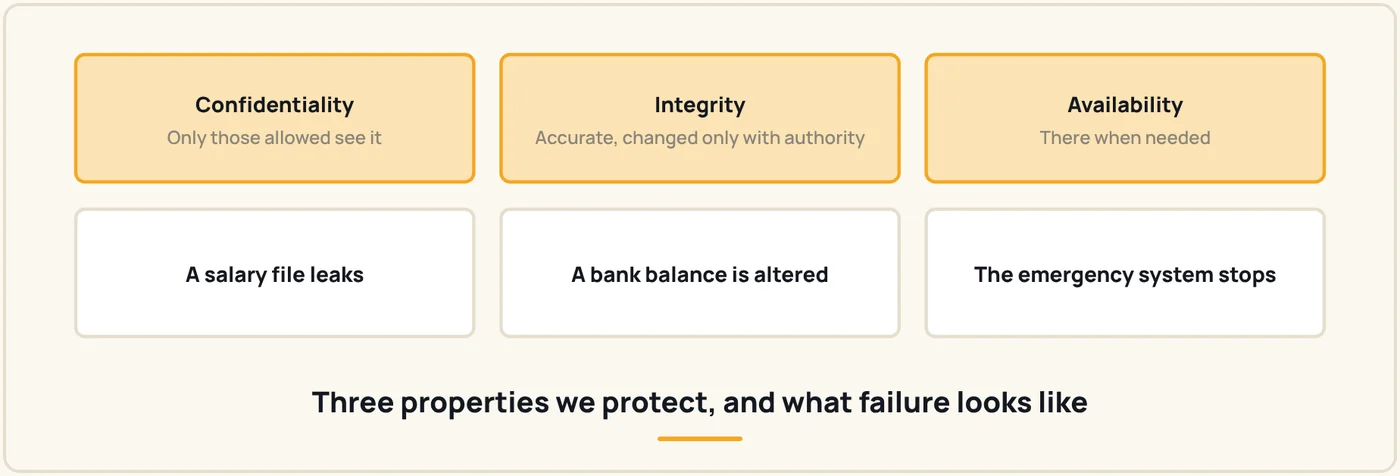
Every security decision in this book comes back to three properties of information. ISO/IEC 27000 defines them, and you will meet them in every clause and every control:
- Confidentiality: information is available only to the people, systems and processes that are allowed to see it.
- Integrity: information is accurate and complete, and nobody changes it without authority.
- Availability: information is there, and usable, when an authorised person needs it.
These three are often called the CIA triad. They sound abstract, but they become very concrete the moment you apply them to a real asset.
Take a salary file. If it leaks, staff learn each other’s pay, trust breaks down, and the organisation may break data protection law. Confidentiality is what matters most.
Take a bank balance. If someone changes it, money appears or disappears, and nobody can trust the bank’s records again. Integrity is what matters most.
Take an emergency dispatch system. If it stops for twenty minutes, an ambulance may arrive too late. Availability is what matters most.
A useful habit, which this book returns to again and again, is to ask of any asset: which of the three would hurt most if it failed, and how badly? The answer tells you where to spend your effort and your budget. It also helps you explain your decisions to managers who are not security specialists, because everyone understands “leak”, “tamper” and “stop”.
Some frameworks add more properties, such as authenticity (we know who sent something), non-repudiation (someone cannot deny having done something) and privacy. They are useful, but each of them can be understood as a special case of the three core properties, and ISO/IEC 27001 is built on the three.
1.3 The Threats Have Changed
The threats organisations face today are more organised, more patient and more professional than they were even five years ago. Understanding them is the first step to understanding why governance matters.
Ransomware has become an industry. Criminal groups no longer work alone. Some write the malware and rent it out; others buy access to victims from “access brokers” who specialise in breaking in; others negotiate the ransom. Most groups now steal data before they encrypt it, so that they can threaten to publish it if the victim restores from backup and refuses to pay. A good backup is still essential, but it no longer ends the story.
The supply chain is the new front door. Attackers have learned that it is often easier to breach a software vendor, a managed service provider or a cloud tenant than to attack a well-defended target directly. One compromised software update can reach thousands of customers in a day. One managed service provider with weak controls can expose every client it manages. Your security is now only as strong as the weakest supplier with access to your systems or data.
People remain the most targeted layer. Phishing emails, phone calls from fake “IT support”, text messages about parcels, and fake invoices from “suppliers” still work, because they target human trust and human haste. Generative AI has made these attacks better: the language is now perfect, the emails are tailored to the target, and a voice can be cloned from a few seconds of recording. A finance officer who receives a call that sounds exactly like the chief executive, asking for an urgent transfer, faces a test that no firewall can pass for them.
The perimeter has dissolved. Twenty years ago, an organisation could imagine its network as a castle with a wall around it. Today, staff work from home and from cafés, data lives in a dozen cloud services, partners connect directly to systems, and devices of every kind join the network. There is no single wall to defend. Security must follow the user, the device and the data wherever they are.
Vulnerabilities are found and exploited faster. When a serious flaw in a widely used product is announced, attackers often start scanning the internet for vulnerable systems within hours. The time an organisation has to patch has shrunk from months to days.
Regulators expect proof. Laws now hold leadership accountable for cyber risk. In the European Union, the NIS2 Directive requires essential and important entities to manage cyber risk, report significant incidents quickly, and make their management bodies responsible for oversight. The Digital Operational Resilience Act (DORA) sets similar requirements for the financial sector. Data protection laws around the world demand that personal data is protected and that breaches are reported, often within 72 hours. Customers, too, now ask for evidence before they sign a contract.
None of these threats can be solved by buying a single product. Each of them needs decisions, owners, processes and checks. That is what governance provides.
1.4 Why Tools Alone Do Not Work
Faced with all this, many organisations respond by buying tools. First a firewall, then an antivirus product, then a monitoring platform, then a data leakage tool, then another. Each tool may be excellent, and the vendors’ presentations may be convincing. And yet, year after year, the organisation stays exposed. Why?
Because security rarely fails inside a tool. It fails in the gaps between tools, and in the gaps between people. Look at the causes of real incidents, and you find the same patterns again and again:
- an account nobody removed when someone left the organisation;
- a supplier nobody assessed before giving them remote access;
- a backup that ran every night but that nobody ever tried to restore;
- a server that was set up “temporarily” two years ago and never patched;
- a policy that exists on the intranet but that nobody has read;
- a risk that everyone knew about but that nobody owned;
- an alert that fired correctly but that nobody was watching.
None of these is a technology failure. Every one of them is a failure of management: of deciding what matters, assigning responsibility, checking that it was done, and improving when it was not.
There is a second problem with the tools-first approach: it spends money on the wrong things. Without a clear view of risk, an organisation tends to buy what is fashionable or what a vendor sells well, rather than what its actual risks require. It may have an expensive threat intelligence platform but no inventory of its own assets. It may have a sophisticated monitoring tool but no one trained to respond to what it finds.
This is exactly the problem a management system solves. It does not replace your tools. It makes sure that the right tools are chosen for the right risks, that someone owns each one, that they are configured and used properly, that they are checked, and that the whole effort improves over time.
1.5 What a Management System Is
A management system is the set of policies, processes, roles, resources and records an organisation uses to reach its objectives in a particular area. You already have management systems, even if you do not call them that. Your finance function has budgets, approvals, accounts and audits. Your quality function, if you have one, has standards, inspections and corrective actions.
An information security management system (ISMS) applies the same discipline to information security. It answers, in a structured and repeatable way, a set of simple questions:
- What information do we have, and what does it need protecting from?
- What are our risks, and which ones matter most?
- Who is responsible for each part of our security?
- What have we decided to do, and why?
- Are we actually doing it?
- Is it working?
- What will we improve next?
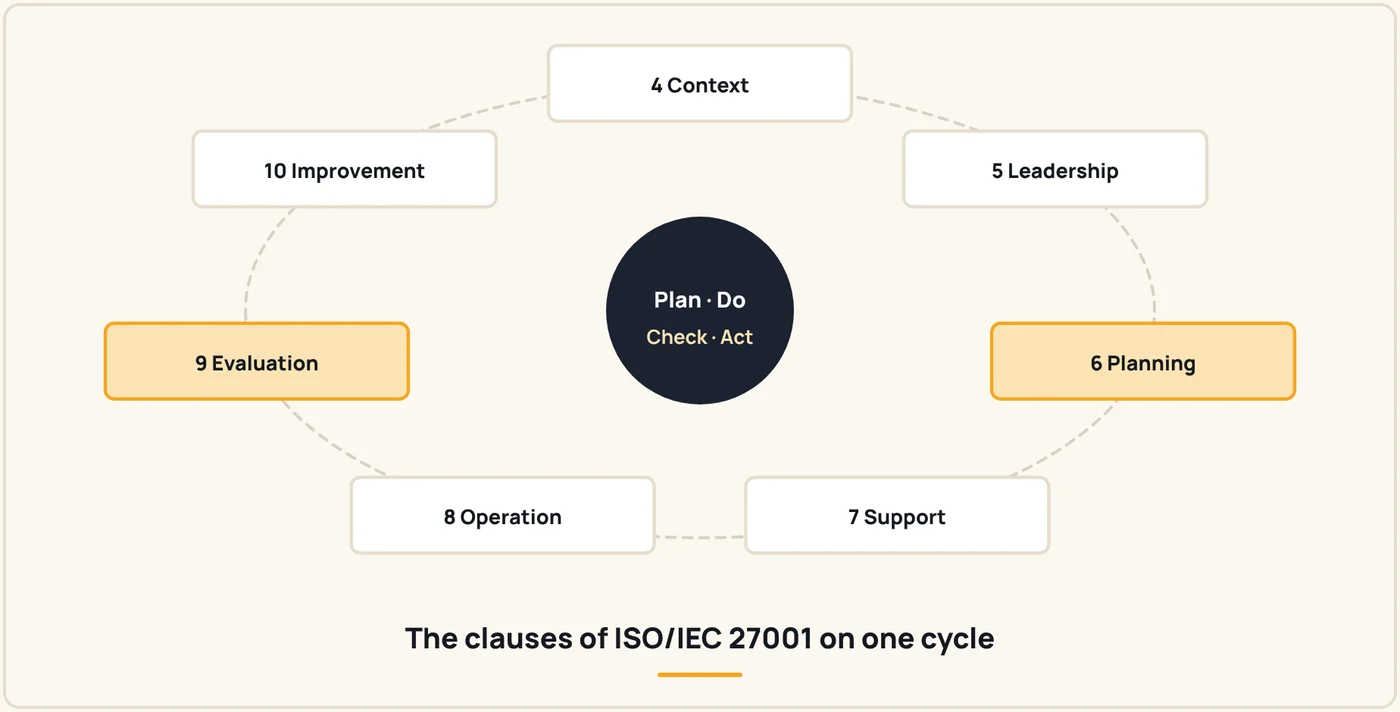
ISO/IEC 27001 describes the requirements for an ISMS. Its heart is a simple, repeating cycle known as Plan, Do, Check, Act, which you will see throughout this book:
- Plan: understand your context and interested parties, assess your risks, set your objectives, and decide what to do (Clauses 4 to 7).
- Do: put the controls and processes in place and run them (Clause 8).
- Check: measure, audit and review whether they work (Clause 9).
- Act: correct what failed and improve what could be better (Clause 10).
Then you go round again. The threats change, the business changes, the technology changes, and so the ISMS changes with them. An ISMS is never “finished”. It is a living part of how the organisation runs.
1.6 Governance, Management and Operations
You will often hear three words used loosely: governance, management and operations. It helps to separate them, because an ISMS touches all three.
- Governance is about direction and oversight. It is the board or top management deciding how much risk the organisation will accept, setting the policy, providing the resources, and holding people accountable. Governance asks: are we doing the right things?
- Management is about planning and coordination. It is the CISO and the managers turning that direction into plans, roles, processes and objectives. Management asks: are we doing things the right way?
- Operations is about doing the work. It is the administrators patching systems, the service desk resetting passwords, the developers reviewing code, the security analysts watching alerts. Operations asks: are we doing it today?
A strong ISMS connects the three. Decisions made at the top reach the work on the ground, and evidence from the ground reaches the top. When that connection breaks, the board believes the organisation is secure while the people doing the work know it is not, or the people doing the work make risk decisions that the board never sees.
1.7 What Good Governance Gives You
An ISMS done well gives an organisation far more than a certificate on the wall. Organisations that run one seriously usually see benefits in six areas:
- Fewer and smaller incidents. Risks are found and treated before they are exploited, and controls are checked rather than assumed.
- Faster, calmer response. When something does go wrong, the plans, the contacts and the roles already exist, so people act rather than improvise.
- Trust that can be shown. Customers, partners, insurers and regulators can be given evidence, often backed by an independent audit, instead of promises.
- Better decisions about money. Spending follows risk rather than fear or fashion, and the organisation can explain why it invests in one control and not another.
- A shared language. The board, the business and the technical teams discuss the same risks in the same terms, which makes it easier to agree on priorities.
- Resilience to change. New systems, suppliers, laws and threats are handled through processes that already exist, rather than through a new project each time.
There is one more benefit that is harder to measure: confidence. Leaders who know their risks and know what is being done about them sleep better, decide faster, and are less likely to overreact when the next headline about a breach appears.
1.8 Common Myths About ISO/IEC 27001
Before going further, it is worth clearing away a few common misunderstandings that often slow organisations down.
“It is an IT standard.” It is not. It is a management standard for information security. Many of its requirements concern leadership, HR, suppliers, legal obligations and physical premises. The IT team carries many controls, but the ISMS belongs to the whole organisation.
“We have to implement all 93 controls.” You do not. You must consider all of them, but you implement those that your risk assessment, laws and contracts require, and you justify the rest in the Statement of Applicability (Chapter 6).
“It is only for large organisations.” Organisations of every size are certified, from teams of ten to multinationals. The standard expects the ISMS to fit the organisation: a small company needs far less documentation and far fewer processes than a large one.
“Certification means we are secure.” Certification means an independent auditor found that your management system meets the standard’s requirements and is working. It does not mean you cannot be breached. It does mean you are managing your risks deliberately and improving, which is the best any organisation can honestly claim.
“It is a one-off project.” It is a cycle that never stops. The certificate itself requires yearly surveillance audits and recertification every three years (Chapter 18), and the real value comes from running the ISMS every day.
“It means a mountain of paperwork.” It means the documentation you need to run and prove your security, no more. Chapter 9 shows how to keep it light.
1.9 Who This Book Is For
This book is written for the people who build and run an ISMS:
- the chief information security officer (CISO) and the security team, who lead the work;
- IT and operations leaders, who carry many of the technical controls;
- risk, compliance and internal audit professionals, who check the controls and report on them;
- HR, legal, procurement and facilities managers, who own important parts of the ISMS without always realising it;
- software and product leaders, wherever the organisation builds software of its own;
- and the executives and board members who must lead, resource and oversee all of the above.
It is for any kind of organisation, large or small, public or private, in any sector. Wherever software is built in-house, Chapter 15 gives secure development the attention it deserves.
You do not need to have read the standard before you start. Each chapter tells you which clause or control it covers, explains it in plain words, shows it in a figure, gives examples, and tells you what an auditor will look for. Most chapters end with the mistakes organisations commonly make, so that you can avoid them. The appendices give you templates, including a Statement of Applicability with all 93 controls, ready to adapt.
You should, however, buy and read the standard itself. This book explains ISO/IEC 27001 and helps you apply it; it does not reproduce it, and it does not replace it.
1.10 How the Book Is Organised
The book follows the order in which you would build an ISMS:
- Part 1, Foundations (Chapters 1 to 3): why governance matters, what is inside ISO/IEC 27001:2022 and its 2024 amendment, and how to structure your ISMS documentation.
- Part 2, Planning (Chapters 4 to 7): context and scope, leadership and policy, risk assessment and treatment with the Statement of Applicability, and objectives and change.
- Part 3, Support and Operation (Chapters 8 to 10): people and resources, documented information, and running the processes day to day.
- Part 4, The Controls of Annex A (Chapters 11 to 15): the organisational, people, physical and technological controls, and secure development and change.
- Part 5, Checking and Improving (Chapters 16 to 18): monitoring and audit, correcting and improving, and the road to certification.
You can read the book from start to finish, as a guide to building an ISMS from nothing. Or you can go straight to the chapter you need, as a reference when you are working on a particular clause or control.
1.11 What to Do First
If you are starting an ISMS, or restarting one that has stalled, these five steps will set you on the right path before you read further:
- Find your sponsor. Identify the senior leader who will own the ISMS at the top. Without one, nothing in this book will stick.
- Ask why. Write down, in one paragraph, why your organisation needs an ISMS now: a customer requirement, a regulation, a recent incident, a growth plan. This becomes the opening of your business case and, later, your policy.
- List what you already have. Most organisations already have some policies, some controls and some records. Collect them; you will build on them, not start from zero.
- Choose a first scope. Decide which part of the organisation matters most and would benefit most from an ISMS. Chapter 4 will help you refine it.
- Buy the standards. Get ISO/IEC 27001:2022 with its Amendment 1:2024, and ISO/IEC 27002:2022. You will use them on every page of this book.
Key Takeaways
- Information is a core part of what every organisation is, so protecting it is a business matter, not only a technical one.
- We protect three properties: confidentiality, integrity and availability. Ask which matters most for each asset.
- Threats are now organised and fast: ransomware as a business, attacks through suppliers, AI-assisted social engineering, and regulators who expect proof.
- Security usually fails in the gaps between tools and people, which is a failure of management.
- An ISMS closes those gaps with a cycle of Plan, Do, Check and Act, connecting governance, management and operations.
- ISO/IEC 27001 is the international standard for an ISMS. You consider all its controls but implement only those your risks require.
Tip: use ← → to move between sections.