

Governing AI
Chapter 1: Why Responsible AI Matters Now
Where this chapter sits in ISO/IEC 42001: the purpose of the standard, and the shape of the AI management system that the rest of the book builds, clause by clause.
1.1 AI Has Moved Into the Heart of the Organisation
A few years ago, AI lived in the lab. A small team tried a model, showed a demo, and the rest of the organisation watched from a distance. Today the picture is different. AI answers your customers, reads your contracts, screens job applicants, writes code, flags fraud, suggests prices, summarises meetings and drafts reports. It sits inside the decisions that shape your business, and often inside decisions that shape people’s lives: who gets a loan, who is called for an interview, which patient is seen first, which transaction is blocked.
Much of this arrived quickly. Generative AI tools reached hundreds of millions of people within months, and many organisations found that their staff were already using them before any policy existed. Vendors added AI features to products the organisation had bought years earlier. Suppliers began using AI to deliver services. In many organisations today, nobody can say with confidence how many AI systems are in use, what data they touch, or who is responsible for them.
As a security leader, I watched this change happen from the inside. Every new AI system brought something useful, and every one brought questions we had never had to answer before. Who is responsible when a model makes a wrong decision? How do we know the data behind it is fair? What happens when someone feeds it a carefully poisoned input? How do we stop staff pasting confidential information into a public chatbot? And how do we explain a model’s decision to a customer, a regulator or a court?
These questions do not belong to the data science team alone. They belong to the leadership of the organisation. In practice they often land on the desk of the CISO, the chief risk officer or the chief AI officer, because these leaders already run the disciplines that know how to manage risk systematically: management systems, controls, audits and continual improvement.
That is what this book is about. ISO/IEC 42001:2023 gives organisations, for the first time, an international standard for an AI management system (AIMS). It does for AI what ISO/IEC 27001 did for information security: it turns good intentions into a system you can plan, run, measure, audit and improve.
1.2 The Promise and the Price
It is worth being clear from the start: this book is not against AI. Used well, AI brings real benefits. It can take repetitive work off people’s hands, find patterns no human would notice, extend services to people who could not be reached before, and help experts make better decisions. Organisations that refuse to use AI will fall behind those that use it well.
But every powerful tool has a price, and the price of AI is a new kind of risk. A spreadsheet does what its formula says. An AI system does what its data and training taught it, which is not always what its designers intended. It can be wrong with great confidence. It can be wrong in ways that fall unfairly on particular groups of people. It can change its behaviour as the world around it changes. And it can be attacked in ways that traditional software cannot.
The aim of an AIMS is not to slow AI down. It is to let the organisation move fast and safely: to say yes to AI with confidence, because it knows how to find and manage the risks, and how to show others that it does.
1.3 The New Risks AI Brings
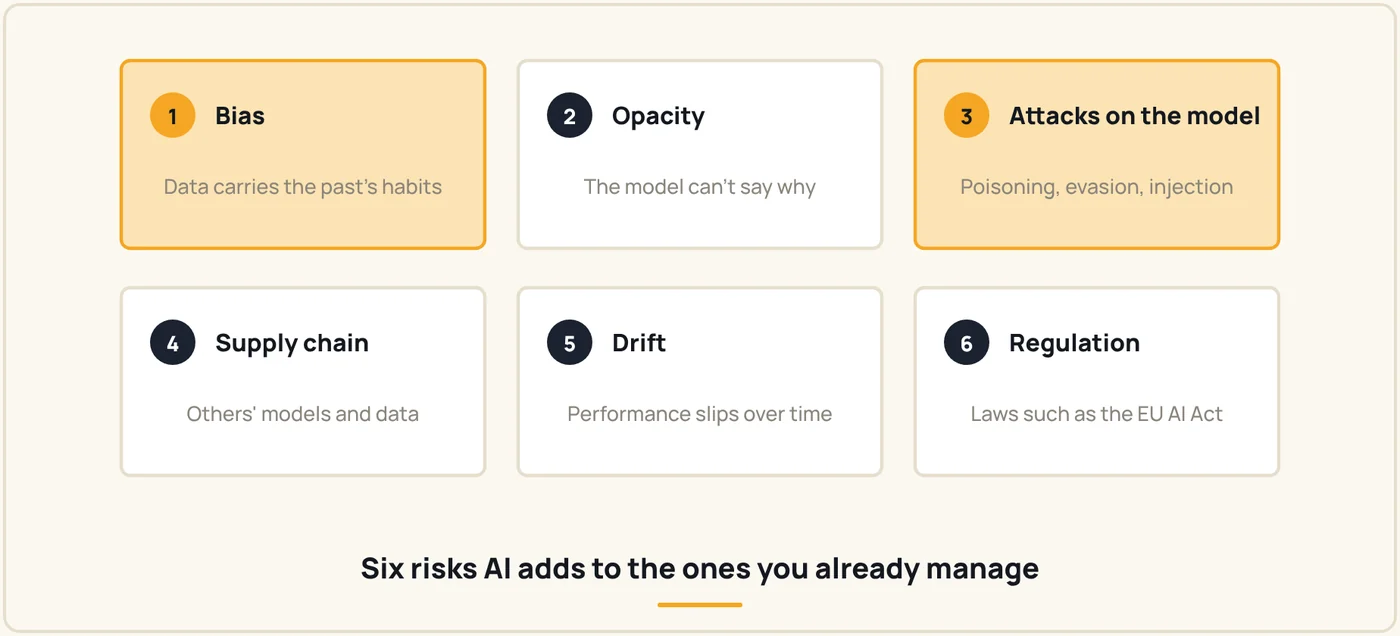
AI does not replace the risks you already manage. It adds new ones on top of them. Six come up again and again.
Bias and unfairness. A model learns from data, and data carries the habits of the past. If last year’s hiring favoured one group, a model trained on it will favour the same group, quietly and at scale. Nobody wrote a biased rule; the bias came in with the examples. Bias can also come from data that under-represents some groups, from labels applied inconsistently, or from choices about what the model should optimise. Because AI decides at scale, a small unfairness repeated a million times becomes a large harm.
Opacity. Many models cannot tell you why they reached a decision. A deep neural network with millions of parameters does not keep a list of reasons. When the decision affects a person, “the model said so” is not an answer you can give, and in many places the law now gives people a right to an explanation of automated decisions that significantly affect them.
Attacks on the model itself. Attackers no longer need to break into your servers to cause harm. They can poison the training data so that the model learns the wrong lessons. They can craft inputs that fool the model, such as an image altered in ways invisible to the human eye. They can inject instructions into a language model’s prompt, hidden in a document or a web page, so that it ignores its rules. They can pull private training data back out of a model by asking it the right questions. And they can steal a model by querying it often enough to copy its behaviour.
A long supply chain. Few organisations build their AI from scratch. They use foundation models, pre-trained components, datasets, cloud platforms and APIs from others, often several layers deep. A weakness anywhere along that chain becomes your weakness: a dataset collected without consent, a model with hidden flaws, a provider that changes its service overnight.
Drift. A model that worked well on launch day can slowly get worse as the world around it changes. Customer behaviour shifts, fraudsters change tactics, a pandemic changes everything at once. Nobody notices until the damage is done, unless someone is watching.
Regulation. Governments now regulate AI directly. The European Union’s AI Act is the most prominent example. It entered into force on 1 August 2024, with its prohibitions on certain practices and its AI literacy duty applying from 2 February 2025, and obligations for general-purpose AI models from 2 August 2025. Following the Digital Omnibus on AI, which has been in force since 27 July 2026, the main obligations for high-risk systems now apply from 2 December 2027 for those listed in Annex III, and from 2 August 2028 for those covered by Annex I. Other countries are following with laws and guidance of their own. An organisation that cannot show how it governs its AI will find it harder to sell, to partner, to win public contracts and to defend itself.
1.4 When Things Go Wrong
These risks are not theoretical. Over the past few years, organisations around the world have learned hard lessons:
- recruitment tools that marked down applications from women, because they had learned from a decade of male-dominated hiring;
- facial recognition systems that made far more errors for people with darker skin, leading to wrongful identifications;
- chatbots that were manipulated by users into producing offensive or false statements within hours of launch;
- customer service bots that promised refunds or policies the organisation did not offer, with courts holding the organisation to the bot’s words;
- staff who pasted confidential source code or customer data into public AI tools, where it left the organisation’s control;
- credit and benefit systems that wrongly denied people support, with serious consequences for families.
In almost every case, the problem was not that the technology was bad. It was that nobody had asked, early enough and seriously enough, what could go wrong, who could be harmed, and what would be done about it. That is a failure of governance, and it is exactly what an AIMS is designed to prevent.
1.5 Responsibility Belongs to the Whole Life Cycle
The most expensive time to discover a problem in an AI system is after it has gone live. By then the data is collected, the model is trained, the users depend on it, and every fix costs more, in money and in trust.
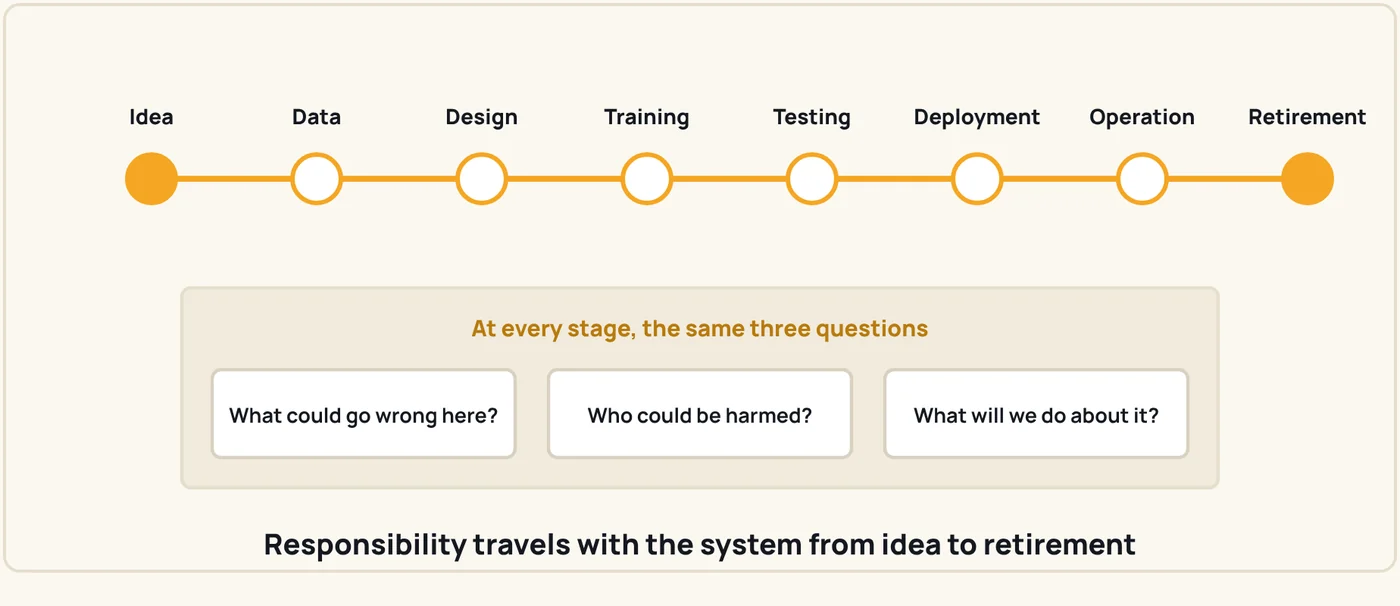
So responsible AI cannot be a final check before launch. It has to travel with the system through every stage of its life: from the first idea, through data collection, design, training, testing, deployment and operation, until the day the system is retired. At each stage you ask the same three questions: What could go wrong here? Who could be harmed? What will we do about it?
When you build this habit into the life cycle, three good things happen. Problems are found while they are still cheap to fix. Compliance becomes a by-product of good practice instead of a scramble before an audit. And responsibility stops being the job of one ethics committee and becomes part of how everyone works: the product owner who defines the purpose, the data engineer who checks the data, the developer who tests for bias, the operator who watches for drift, and the manager who decides when a human must stay in the loop.
1.6 What “Responsible AI” Means
“Responsible AI” is used in many ways, and it helps to be concrete. Across the major frameworks, and in Annex C of ISO/IEC 42001, the same handful of principles appear:
- Fairness: the system does not create or reinforce unjustified differences in how people or groups are treated.
- Transparency and explainability: people know when they are dealing with AI, and decisions can be explained in terms they can understand.
- Accountability: a named person or role is responsible for the system and its outcomes.
- Safety and robustness: the system works reliably as intended, including in unexpected conditions, and fails safely.
- Security: the system and its data are protected against attack and misuse.
- Privacy: personal data is collected, used and protected lawfully and respectfully.
- Human oversight: people can understand, monitor and, where needed, override the system.
- Sustainability: the environmental cost of training and running the system is considered.
These principles are easy to agree with and hard to apply. An AIMS is the machinery that turns them into requirements, tests, roles, records and decisions.
1.7 ISO/IEC 42001 at a Glance
ISO/IEC 42001 was published in December 2023. It applies to any organisation that develops, provides or uses AI systems, whatever its size, type or sector. Like ISO/IEC 27001 and ISO 9001, it follows the harmonised structure that ISO uses for all its management system standards, so it sits comfortably beside the systems you may already run.
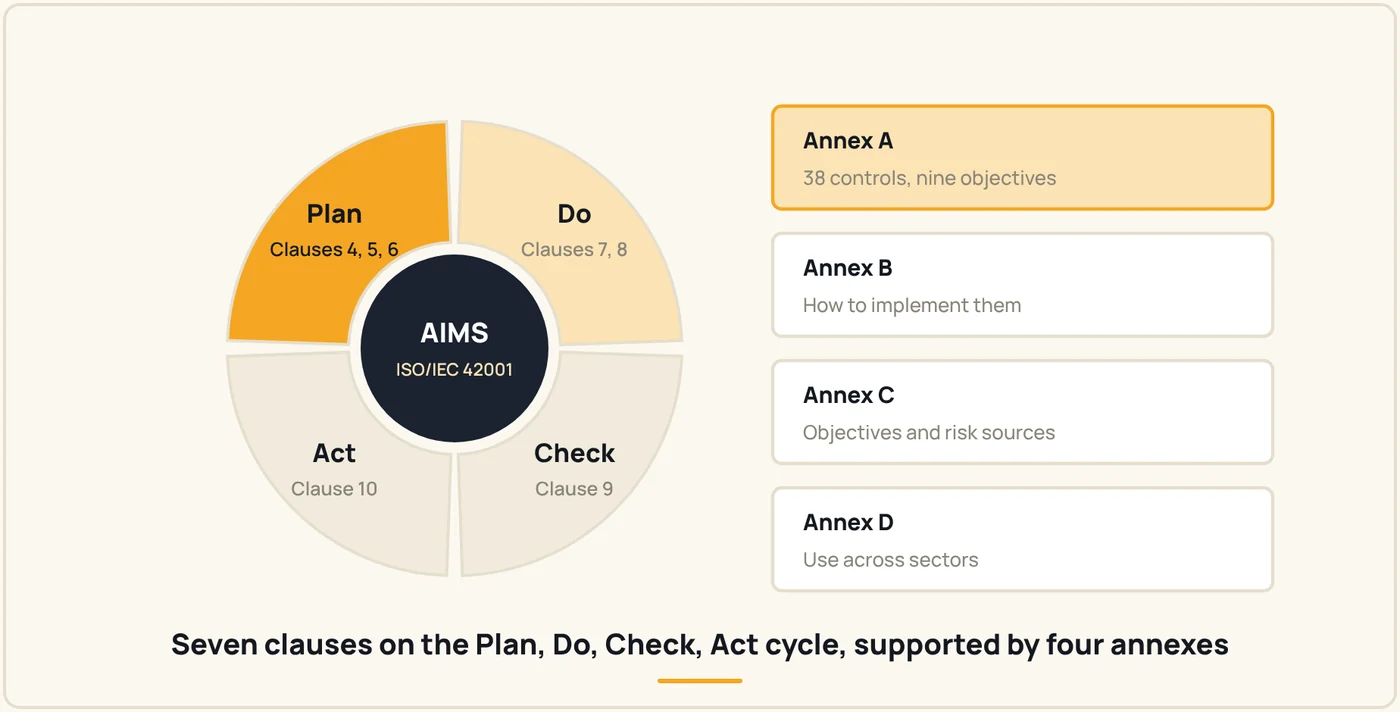
Its requirements are set out in seven clauses, from Clause 4 to Clause 10. They follow the familiar Plan, Do, Check, Act cycle:
- Plan. Understand your context and scope (Clause 4), commit leadership and set the AI policy (Clause 5), assess AI risks and impacts and set objectives (Clause 6).
- Do. Provide the resources, competence and documents the system needs (Clause 7), and run the processes that control your AI systems (Clause 8).
- Check. Monitor and measure, audit the system and review it at management level (Clause 9).
- Act. Correct what went wrong and keep improving (Clause 10).
Four annexes support the clauses. Annex A lists 38 reference controls under nine objectives, from the AI policy to supplier relationships. Annex B explains how to implement them. Annex C gives examples of AI objectives and risk sources. Annex D shows how the system applies across sectors and alongside other management systems.
1.8 Why a Management System, and Not Just Principles?
Many organisations have published AI principles. Few can show how those principles are applied to a particular system on a particular day. The gap between principle and practice is where harm happens.
A management system closes that gap. It makes sure that:
- every AI system is known, and has an owner;
- every system’s risks and impacts are assessed with a consistent method before it goes live, and again when it changes;
- the controls chosen are recorded and justified;
- people have the competence they need, and know their part;
- the system is monitored once it is live;
- someone checks independently whether all of this actually happens;
- top management reviews the results and decides what to improve.
None of this is glamorous, but it is what distinguishes an organisation that hopes its AI is responsible from one that can show it is.
1.9 Who This Book Is For
This book is written for the people who build and run an AIMS:
- chief AI officers, CISOs, chief risk officers and chief data officers, who often lead the work;
- data scientists, machine learning engineers and product owners, who build and operate AI systems;
- risk, compliance, legal, privacy and internal audit professionals, who check them;
- procurement teams, who buy AI products and services;
- and the executives and board members who must lead, resource and oversee all of the above.
It is for organisations of any size and sector, whether they develop AI, provide it to others, or simply use AI that someone else built. You do not need to be a data scientist to follow it, and you do not need to have read the standard first. Each chapter explains the requirements in plain words, shows them in figures, gives examples, and tells you what an auditor will look for. You should, however, buy and read ISO/IEC 42001 itself: this book explains and applies it; it does not reproduce it.
1.10 How This Book Is Organised
This book walks through the standard in the order you will implement it. Each chapter opens with a short note telling you which clauses and controls it serves, so you always know where you are in the standard.
- Part 1, Introduction (Chapters 1 and 2) explains why the standard matters and what an AI management system manual contains.
- Part 2, Building the Foundation (Chapters 3 to 5) covers the standard itself, the context and scope, and leadership.
- Part 3, Planning (Chapters 6 to 8) covers AI risk assessment and treatment, AI system impact assessment, and objectives and change.
- Part 4, Operation (Chapters 9 and 10) puts the system to work across the AI life cycle and in your documentation.
- Part 5, A Culture of Responsibility (Chapters 11 to 13) builds competence and awareness, evaluates performance, and keeps improving.
- The appendices give you templates you can adapt, a risk register, an impact assessment, an incident response guide, a map of ISO/IEC 42001 to other standards and laws, a glossary, references, and a table of all 38 Annex A controls showing where this book covers each one.
Read it from start to finish if you are building an AIMS for the first time. If you already run one, go straight to the chapter you need.
1.11 What to Do First
If you are starting today, five steps will set you on the right path:
- Find your sponsor. Identify the senior leader who will own the AIMS at the top.
- Make a first list. Ask every department which AI systems and tools they use, build or buy. The list will be incomplete, and longer than you expect; both are useful discoveries.
- Set an interim rule for generative AI. If staff use public AI tools, publish a short interim guideline now on what may and may not be shared with them, while the full policy is developed.
- Identify your role. For your main AI systems, note whether you develop them, provide them to others, use them, or several of these (Chapter 4).
- Buy the standards. Get ISO/IEC 42001:2023, and consider ISO/IEC 23894 (risk) and ISO/IEC 42005 (impact assessment).
Whatever you do, keep one idea in mind: responsible AI is not a destination you reach once. It is a habit your organisation keeps.
Key Takeaways
- AI now sits inside decisions that shape businesses and people’s lives, often faster than governance has kept up.
- AI adds new risks: bias, opacity, attacks on models, a long supply chain, drift, and direct regulation such as the EU AI Act.
- Most real AI failures were failures of governance: nobody asked early enough what could go wrong and who could be harmed.
- Responsibility must travel with the AI system through its whole life cycle.
- ISO/IEC 42001 turns responsible AI principles into a management system that can be planned, run, measured, audited and improved.
Tip: use ← → to move between sections.