

Guide 1 · Mathematics of Artificial Intelligence
Guide map
Every artificial intelligence model, no matter how complex it looks, rests on seven mathematical pillars. It turns data into numbers with linear algebra, measures what it does not know with probability, judges what it sees with statistics, finds the direction of improvement with calculus, walks along it step by step with optimisation, measures its error with information theory, and then we ask it the most important question of all: has it truly learnt, or has it merely memorised?
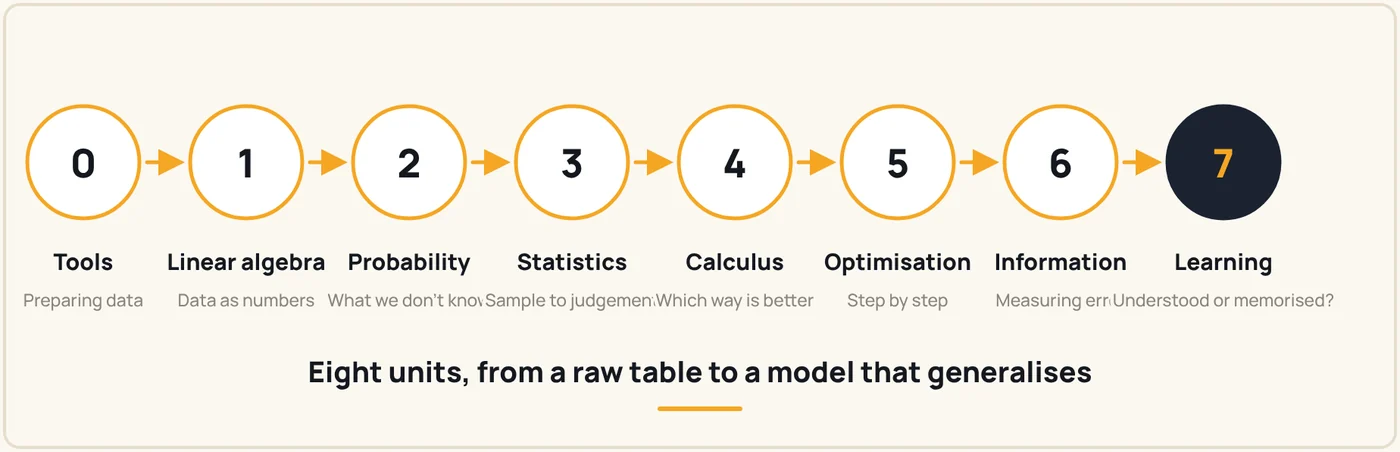
This guide offers a complete curriculum in eight units: a starter unit for the tools, followed by one unit for each pillar. In every lesson, you grasp the idea in plain language, see a diagram that sums it up, try an example yourself in a few lines of Python, find out where you meet it in the models you use every day, and then work through exercises and check their solutions.
All you need beforehand is secondary-school mathematics, along with Python and the NumPy and Pandas libraries. Go in order, run every example yourself, and do not read the solution to an exercise before you have had a go at it. We have chosen illustrative numbers in the examples to explain the ideas.
Tip: use ← → to move between sections.